Edu & Research
Professor Lee Jae-hyun of the Department of Creative Convergence Proposes New Interface Design Strategy to Simultaneously Improve OLED Efficiency and Lifespan
작성자기획과 조회수49 등록일2026-08-11
- Improved reliability of OLED displays expected to drive widespread adoption not only in small smart devices but also in equipment such as monitors
□ Hanbat National University (President Oh Yong-jun) announced that a joint research paper in which Professor Lee Jae-hyun of the Department of Creative Convergence participated as corresponding author was published online in 'Chemical Engineering Journal' (Impact Factor 12.5), an internationally renowned academic journal published by Elsevier, a global science and technology publisher.
○ Titled "Negative giant surface potential engineering for suppressing exciton polaron quenching in organic light emitting diodes", this paper had Hanbat National University's Park Jae-yong, Samsung Electronics SAIT's Lee Yeon-gyeong, and Hanbat National University Key Research Institute Project Group researcher Choi Young-wook participate as joint first authors, while Dr. Kim Jong-soo of Samsung Electronics SAIT and Professor Lee Jae-hyun of Hanbat National University participated as joint corresponding authors.
□ Through this study, the research team identified the key cause that simultaneously reduces OLED efficiency and lifespan, and proposed a new interface design strategy to control it.
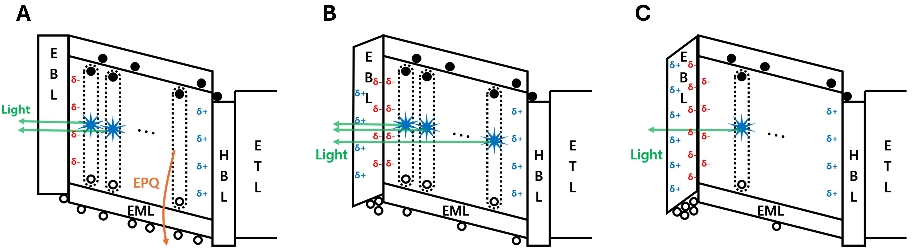
○ Giant Surface Potential (GSP) is formed due to Spontaneous Orientation Polarization (SOP) inside OLEDs, which causes excessive holes to accumulate around the emitting layer, resulting in exciton polaron quenching (EPQ).
○ Such EPQ is known to be a major cause of reducing the luminous efficiency and long term reliability of OLEDs.
○ The research team proposed a new OLED design strategy to precisely control interface charges by introducing an Electron Blocking Layer (EBL) with a negative (-) GSP.
○ In addition, through diverse electrical and optical analyses, the team systematically identified the mechanism of interface charge accumulation and EPQ occurrence, confirming that while an EBL with an appropriate magnitude of negative GSP suppresses unnecessary hole accumulation to reduce EPQ and improve efficiency and operational stability, an EBL with an excessively large negative GSP excessively suppresses hole injection instead, which can degrade OLED performance.
○ Through this, the team presented optimal GSP design criteria for improving OLED performance; in particular, OLEDs applying the optimal negative GSP proposed by the research team showed an improvement in operational lifetime (LT95) of about 119.5% compared to the reference device, demonstrating the achievement of simultaneously improving efficiency and operational lifespan.
○ The results of this study are expected to be utilized not only for OLEDs but also for interface design technologies of diverse optoelectronic devices based on organic semiconductors.
□ Professor Lee Jae-hyun stated, "This study experimentally identified that exciton polaron quenching, the fundamental cause of optical energy loss, can be effectively suppressed by precisely controlling interface charge behavior inside OLEDs," adding, "We expect it will be utilized as a new design strategy to enhance the efficiency and reliability of diverse organic optoelectronic devices going forward."
□ Meanwhile, this study was conducted as a joint research project with Samsung Electronics SAIT, and was supported by the [Ministry of Education and National Research Foundation of Korea / Key Research Institute Support Project (2018R1A6A1A03026005); Active Printed Electronics Systems Using Hybrid 3D Printing] and the [Ministry of Science and ICT and National Research Foundation of Korea Basic Research Project (RS-2024-00359103); Identification of Electron Spin Behavior and Applications Through Development of Electroluminescent Magnetic Resonance Devices].