Basic Guidelines for Personal Information Protection
Welcome to the official website of Hanbat National University. Thank you for using our university website.
We would like to explain our personal information protection policy for this website, which is based on the current Personal Information Protection Act. Unless otherwise specified, this policy applies to all websites operated by the university.
| [Key Personal Information Processing Labels] | ||||
|---|---|---|---|---|

|

|

|

|

|
| Collection of Personal Information | Purpose of Processing Personal Information | Personal Information Retention Period | Provision of Personal Information to Third Parties | Outsourcing of Personal Information Processing |

|

|

|

|

|
| Rights and Obligations of Legal Representatives | Measures to Ensure Safety | Personal Information Protection Officer | Request for Access to Personal Information | Remedies for Infringement |
Personal Information Protection Policy
Hanbat National University complies with the Personal Information Protection Act and related laws and regulations to protect the freedom and rights of data subjects, and processes personal information lawfully and manages it securely. Accordingly, pursuant to Article 30 of the Personal Information Protection Act, the university establishes and discloses this Personal Information Protection Policy as follows to inform data subjects of the procedures and standards for processing personal information and to handle related grievances promptly and smoothly.
Article 1 (Purpose of Processing Personal Information)
Hanbat National University processes personal information for the following purposes. Personal information being processed will not be used for any purpose other than the following, and when the purpose of use changes, the university will obtain separate consent and take the necessary measures pursuant to Article 18 of the Personal Information Protection Act.
① Website membership registration and management
Identity verification and identification for use of membership services provided by Hanbat National University (admissions, academic affairs, student affairs, library, online education, teaching and learning, research, health care, etc.), prevention of unauthorized use of services, age verification, retention of records for dispute resolution, and delivery of notices
② Admissions and academic affairs
Admission screening, selection of new students, academic and university administration, and management of international students
③ Provision of services and handling of civil petitions
Scholarship administration, student loans, library book checkout and returns, user management, management of dormitory residents, academic management of Lifelong Education Institute students, employment support, health management, support for students with disabilities, verification of petitioners’ requests and notification of results, and investigation and handling of cases filed with the Human Rights Center and related fact-finding surveys
④ Development fund
Management of development fund donors and issuance of donation receipts
Article 2 (Items Processed and Retention Period of Personal Information, and Registration Status of Personal Information Files)
Pursuant to Article 32 of the Personal Information Protection Act, Hanbat National University registers and discloses its personal information files as follows.
※ The registered personal information files of Hanbat National University can be viewed on the Personal Information Protection Portal of the Personal Information Protection Commission (www.privacy.go.kr) ▷ Personal Services (개인서비스) ▷ Exercise of Data Subject Rights (정보주체 권리행사) ▷ Request for Access, etc. to Personal Information (개인정보의 열람 등 요구) ▷ by entering “국립한밭대학교” (Hanbat National University) as the institution name.
Hanbat National University processes personal information within the retention and use period prescribed by laws and regulations, or within the retention and use period consented to by the data subject at the time of collection.
The purpose of processing, items, and retention period of personal information are set differently according to the characteristics of each personal information file, and the details of each file are as follows.
-
Attachment 1. List of Personal Information Files Held (Download) Download
Article 3 (Provision of Personal Information to Third Parties)
Pursuant to Articles 17 and 18 of the Personal Information Protection Act, Hanbat National University provides personal information to third parties only in the following cases.
① Where separate consent has been obtained from the data subject
② Where the personal information is provided within the scope of the purposes for which it is collected, in the following cases:
A. Where special provisions exist in other statutes or it is unavoidable due to obligations under statutes or regulations;
B. Where it is unavoidable for a public institution’s performance of duties under its jurisdiction as prescribed by statutes or regulations, etc.;
C. Where it is deemed manifestly necessary for the protection, from imminent danger, of life, body, and property interests of the data subject or a third party;
D. Where it is necessary to attain the legitimate interests of a personal information controller and such interests are manifestly superior to the rights of the data subject (in such cases, processing shall be allowed only to the extent the processing is substantially related to the legitimate interests of the personal information controller and does not go beyond a reasonable scope.);
E. Where it is urgently necessary for public safety and security, such as public health.
Pursuant to Article 17 (4) of the Personal Information Protection Act and Article 14-2 of the Enforcement Decree of the same Act, Hanbat National University may provide personal information without the consent of the data subject, taking into account the following:
① Whether it is reasonably related to the original purpose for which the personal information was collected;
② Whether additional use or provision of personal information is foreseeable in light of the circumstances under which the personal information was collected or processing practices;
③ Whether it unfairly infringes on the interests of the data subject;
④ Whether the measures required to ensure safety, such as pseudonymization or encryption, have been taken.
Where additional use or provision of personal information without the consent of the data subject occurs continuously, Hanbat National University will disclose the criteria for judging the above considerations in this policy and examine whether personal information is additionally used or provided in accordance with those criteria.
Hanbat National University provides personal information to third parties as follows.
-
Attachment 2. Status of Provision of Personal Information to Third Parties (Download) Download
Article 4 (Outsourcing of Personal Information Processing)
Hanbat National University outsources personal information processing for smooth handling of its duties. Pursuant to Article 26 (2) of the Personal Information Protection Act, the details of the outsourced work and the outsourced service provider are disclosed as follows.
-
Attachment 3. Status of Outsourcing of Personal Information Processing (Download) Download
When concluding an outsourcing contract, Hanbat National University specifies in the contract the prohibition of processing personal information for purposes other than the outsourced work, technical and managerial protection measures for personal information, management and supervision of the outsourced service provider, and liability such as compensation for damages, and supervises whether the outsourced service provider processes personal information safely.
Article 5 (Procedures and Methods for Destruction of Personal Information)
In principle, Hanbat National University destroys personal information without delay when it becomes unnecessary, such as upon expiry of the retention period or achievement of the purpose of processing. However, this does not apply in cases where the information must be preserved under other statutes or regulations.
The procedures and methods for destroying personal information are as follows.
Destruction procedure
Hanbat National University establishes a destruction plan for personal information that must be destroyed and destroys it accordingly. Hanbat National University selects personal information for which grounds for destruction have arisen and destroys it with the approval of the Hanbat National University Personal Information Protection Officer (Secretary General).
Destruction method
Personal information recorded and stored in electronic file form is destroyed so that the records cannot be reproduced, and personal information recorded and stored in paper documents is destroyed by shredding or incineration.
Article 6 (Rights and Obligations of Data Subjects and Methods of Exercising the Same)
Data subjects may exercise the following rights, and the legal representative of a child under the age of 14 may request access to, correction or erasure of, or suspension of the processing of the child’s personal information.
① Request for access to personal information
Data subjects may request access to their personal information pursuant to Article 35 of the Personal Information Protection Act. However, access may be restricted in any of the following cases pursuant to Article 35 (4) of the same Act.
A. Where access is prohibited or limited by statutes;
B. Where access may cause damage to the life or body of a third party, or unjustified infringement of property and other interests of any other person;
C. Where a public institution has grave difficulties in performing any of the following duties:
1) Imposition, collection or refund of taxes;
2) Evaluation of academic achievements or admission affairs at schools at all levels established under the Elementary and Secondary Education Act and the Higher Education Act, lifelong educational facilities established under the Lifelong Education Act, and other higher educational institutions established under other statutes;
3) Testing and qualification examination regarding academic competence, technical capability, and employment;
4) Ongoing evaluation or decision-making in relation to compensation or grant assessment;
5) Ongoing audit and examination under other statutes.
② Request for correction or erasure of personal information
Data subjects may request correction or erasure of their personal information pursuant to Article 36 (Correction or Erasure of Personal Information) of the Personal Information Protection Act. However, erasure may not be requested where other statutes or regulations specify the personal information as subject to collection.
③ Request for suspension of processing of personal information
A data subject may request the relevant personal information controller to suspend the processing of his or her personal information or may withdraw his or her consent to personal information processing, pursuant to Article 37 of the Personal Information Protection Act. Upon receipt of a request for suspension or withdrawal, the university will take the necessary measures without delay, such as destroying collected personal information to prevent recovery and reproduction thereof. However, pursuant to Article 37 (2) of the same Act, a request for suspension may be denied, or measures following withdrawal may not be taken, in any of the following cases.
A. Where special provisions exist in other statutes or it is unavoidable to observe obligations under statutes or regulations;
B. Where access may cause damage to the life or body of a third party, or unjustified infringement of property and other interests of any other person;
C. Where a public institution cannot perform its work as prescribed by any statutes or regulations without processing the personal information in question;
D. Where it is impracticable to perform a contract such as the provision of services as agreed upon with the said data subject without processing the personal information in question, and the data subject has not clearly expressed desire to terminate the agreement.
When a request is denied for any of the above reasons, the university will notify the reasons for refusal or non-action without delay.
④ Methods of requesting access, correction or erasure, suspension of processing, and exercise of rights
Data subjects may exercise their rights to access, correction or erasure, and suspension of processing of personal information in accordance with [Annex Form No. 1] of the Ministry of Education Guidelines on Personal Information Protection, in writing, by e-mail, or by fax, or in person at the university after completing the identity verification procedure.
※ Identity verification procedure for data subjects
Data subject: Submit an identification document (one officially recognized by an administrative agency and not easily altered or misused, such as a resident registration card or driver’s license)
Legal representative of the data subject: Submit a power of attorney in accordance with [Annex Form No. 2] of the Ministry of Education Guidelines on Personal Information Protection and a document proving legal representation
Person delegated by the data subject: Submit a power of attorney in accordance with [Annex Form No. 2] of the Ministry of Education Guidelines on Personal Information Protection and identification documents, such as resident registration cards, of the delegator and the agent
⑤ Procedure for raising objections when a request to exercise rights is denied
A. When the relevant department postpones or denies a request for access, etc., it notifies the data subject of the justifiable reasons and the methods for raising objections within 10 days from the date of the request
B. The relevant department receives the data subject’s objection (in writing, by telephone, by e-mail, etc.), and the person in charge of personal information protection reviews the details
C. The personal information protection officer for each field conducts the final review of the processing results
D. The relevant department notifies the data subject of the processing results
Procedures for Access, Correction, Erasure, and Suspension of Processing of Personal Information
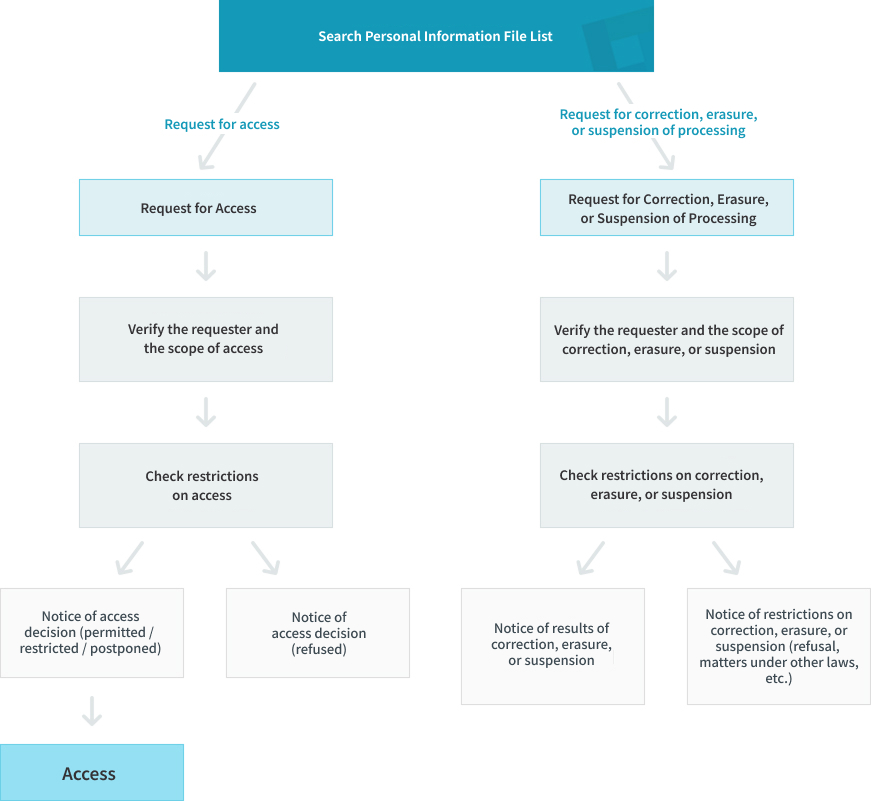
How to Request Access, etc. to Personal Information
※ Requests for access, correction or erasure, and suspension of processing of personal information may be submitted directly to Hanbat National University (offline) or through the Personal Information Protection Portal (www.privacy.go.kr).
| Online (Internet) | Offline (Written Application) |
|---|---|
|
|
Article 7 (Measures to Ensure the Safety of Personal Information)
Pursuant to Article 29 of the Personal Information Protection Act, Hanbat National University takes the following technical, managerial, and physical measures necessary to ensure safety.
① Managerial measures: Establishment and implementation of an internal management plan, regular staff training
② Technical measures: Access control for personal information processing systems, encryption of personally identifiable information, installation of security programs
③ Physical measures: Access control for computer rooms, data storage rooms, etc.
Article 8 (Installation and Operation of Devices that Automatically Collect Personal Information and Refusal Thereof)
Purpose of using cookies
- Hanbat National University uses “cookies,” which store and retrieve information about users periodically, to provide personalized services. Cookies are small amounts of information that a website server sends to the user’s computer browser and are stored on the hard disk of the user’s computer.
Installation, operation, and refusal of cookies
- A) Users have the choice of whether to accept cookies. Accordingly, users may allow or refuse all cookies, or be asked for confirmation each time a cookie is stored, by adjusting the options in their web browser.
- How to specify whether to allow cookies:- Go to the [Tools] menu and select [Internet Options].
- In the [Privacy] tab, set the “privacy level.”
- B) When users refuse to store cookies, the users may not be able to use some services provided by Hanbat National University, such as personalized services.
- You can refuse to store cookies through the option settings in Tools > Internet Options > Privacy at the top of your web browser; if you do so, the use of some related services provided by Hanbat National University, such as the library, may be restricted. - C) To provide personalized services, Hanbat National University may automatically collect and store the following information about users:
- 1. Address of the website requested when visiting the website
- 2. User IP address, browser request type and protocol version, and cookie information
- 3. Date and time of visit and addresses of visited pages
- 4. Location information via beacons and RFID tag information
- 5. IMEI (International Mobile Equipment Identity; mobile device identification code)
Information automatically collected and stored as described above will be used for statistical analysis to provide better services and for smooth communication between users and the website. It may also be submitted to relevant agencies when necessary under relevant laws and regulations. However, user beacon location information and IMEI (mobile device identification code) are collected only when accessing from a mobile device, and location information is not stored.
Article 9 (Personal Information Protection Officer and Department in Charge of Personal Information Protection)
Hanbat National University designates a Personal Information Protection Officer as follows to take overall charge of and responsibility for the processing of personal information and to handle complaints and provide remedies for damage suffered by data subjects related to the processing of personal information.
Hanbat National University Personal Information Protection Officer
- Name : Choi Yong-ha
- Position : Acting Secretary General
- Contact : 042-821-1037
The department in charge of personal information protection at Hanbat National University is as follows, and data subjects may submit requests for access to personal information pursuant to Article 35 of the Personal Information Protection Act to that department.
Hanbat National University Person in Charge of Personal Information Protection (Administration)
- Department : Bureau of General Administration
- Name : Nam Cheong-ha
- Contact : 042-828-8617
Hanbat National University Person in Charge of Personal Information Protection (IT)
- Department : Office of Information System & Technology
- Name : Lee Jeong-uk
- Contact : 042-821-1392
Personal information protection officer for each field: Head of each department (ex officio)
Article 10 (Remedies for Infringement of Rights and Interests)
To obtain remedies for infringement of personal information, data subjects may apply for dispute resolution or counseling to the Personal Information Dispute Mediation Committee, the Personal Information Infringement Report Call Center of the Korea Internet & Security Agency, etc. For other reports of and consultation on personal information infringement, please contact the agencies below.
Personal Information Infringement Report Call Center:
- 소Responsibilities : Reports of personal information infringement, requests for counseling
- Website : privacy.kisa.or.kr
- Phone: (no area code) 118
- Address : (58324) 9, Jinheung-gil, Naju-si, Jeonnam-Gwangju (Personal Information Infringement Report Call Center, Korea Internet & Security Agency)
Personal Information Dispute Mediation Committee:
- Responsibilities : Applications for personal information dispute mediation, collective dispute mediation (civil resolution)
- Website : www.kopico.go.kr
- Phone : (no area code) 1833-6972
- Address: (03171) 12F, Government Complex Seoul, 209 Sejong-daero, Jongno-gu, Seoul
Supreme Prosecutors’ Office: (no area code) 1301, (www.spo.go.kr)
Korean National Police Agency: (no area code) 182 (http://https://ecrm.police.go.kr)
Article 11 (Operation and Management of Fixed Visual Data Processing Devices)
Hanbat National University installs and operates fixed visual data processing devices as follows.
1. Legal basis and purpose of installing fixed visual data processing devices
Pursuant to Article 25 (1) of the Personal Information Protection Act, Hanbat National University installs and operates visual data processing devices for the following purposes.
- - Facility safety and fire prevention
- - Crime prevention
2. Number of devices, installation locations, and recording range
- - Number of devices: 530
- - Installation locations: “N” buildings including the University Headquarters (N1), “S” buildings including the International Exchange Hall (S0), tennis courts, Regional Cooperation Hall (E1), Student Housing (D1–6), Workplace Daycare Center, vehicle entrances, etc.
- - Recording range: Building entrances and major facilities of each building on campus
-
Attachment 4. List of CCTVs Held Download
3. Manager and persons authorized to access visual data
4. Recording hours, retention period, storage location, and processing method of visual data
| Recording Hours | Retention Period | Storage Location and Processing |
|---|---|---|
| 24 hours | Within 30 days from the date of recording | Stored and processed in the visual data processing device control room of the Integrated Control Center |
5. Outsourcing of installation and management of visual data processing devices
Hanbat National University outsources the installation and management of visual data processing devices as follows, and, in accordance with relevant laws and regulations, specifies in the outsourcing contract the necessary matters to ensure that personal information is managed safely.
| Outsourced Service Provider | Person in Charge | Contact |
|---|---|---|
| Samkyung MS | Kim Jun-ho | 042-821-1047 |
6. Methods and places for checking personal visual data
- - Method: Contact the visual data manager in advance → Complete the request form for confirmation of existence of and access to personal visual data in accordance with [Annex Form No. 2] of the Standard Personal Information Protection Guidelines and submit it to the department in charge
- - Place: Campus CCTV – Integrated Control Center / Vehicle entrance CCTV – Bureau of General Administration
7. Measures in response to data subjects’ requests for access, etc. to visual data
To request confirmation of existence of, access to, or erasure of personal visual data, an application must be made by filing the request form for confirmation of existence of and access to personal visual data in accordance with [Annex Form No. 2] of the Standard Personal Information Protection Guidelines.
Access is permitted only in cases where the data subject has been recorded or where it is manifestly necessary for the life, body, or property of the data subject.
8. Technical, managerial, and physical measures to protect visual data
- - Technical measures: Encryption of visual data processing devices
- - Managerial measures: Establishment of an internal management plan, access control, and restriction of access rights
- - Physical measures: Provision of storage facilities and installation of locking devices
9. Amendments to the policy on operation and management of fixed visual data processing devices
The Hanbat National University policy on the operation and management of fixed visual data processing devices was established on March 1, 2012. When any content is added, deleted, or modified due to changes in laws, policies, or security technology, the reasons for and details of the changes will be announced on the university website at least 7 days before implementation.
- Announcement date: January 1, 2019 / Effective date: January 1, 2019
Article 12 (Operation and Management of the Administrative Telephone Recording System)
Hanbat National University installs and operates an administrative telephone recording system as follows.
① Legal basis and purpose of installing the administrative telephone recording system
Pursuant to Article 3 (Protection of Secrets of Communications and Conversation) of the Protection of Communications Secrets Act, Article 15 (Collection and Use of Personal Information) (1) 6 of the Personal Information Protection Act, and the Hanbat National University Personal Information Protection Policy, Hanbat National University operates and manages a telephone recording system for the following purposes.
The administrative telephone* recording system** is installed to create a safe environment for civil petitions, prevent disputes between civil petition officers and petitioners in advance, and improve the quality of inclusive civil petition services.
* Administrative telephone: All administrative telephones with assigned line numbers provided through the Hanbat National University telephone exchange
** Recording system: A device capable of storing the contents of calls made on administrative telephones
② Scope of operation of the administrative telephone recording system
| Category | Installation Location | Applies To | Recording Method |
|---|---|---|---|
| Administrative telephone recording system | Hanbat National University(Yuseong Deokmyeong Campus) Telecom Room | All administrative telephones on Yuseong Deokmyeong Campus (excluding Regional Cooperation Hall and Daedeok Campus) |
Manual switching |
③ Manager and persons authorized to access the administrative telephone recording system
- ○ Hanbat National University designates the manager and persons authorized to access the system as follows to protect recording files and to handle personal information matters such as access to and provision of recording files.
- · Manager: Secretary General (042-821-1037)
- · Persons authorized to access
| Department | Position | Contact | Duties |
|---|---|---|---|
| Bureau of General Administration, Secretariat | Person in charge of personal information | 042-828-8617 | - Review of access to and provision of recording files - Establishment of the policy on operation and management of the recording system |
| Facilities Division, Secretariat | Telecom Room officer | 042-821-1057 | - Management of the recording system in the Telecom Room - Access to and protection of recording files |
④ Principles for operation and management of the administrative telephone recording system
- ○ Recording files shall be collected only within the scope consistent with the purpose of installing the recording system, and no one may record or listen to telephone conversations between other persons that are not made public.
- ○ Before recording, the other party is notified that the call will be recorded. However, separate consent must be obtained when collecting personal information (name, contact information, date of birth, etc.) during recording.
- ○ In principle, recording files are retained for one month, and the files are deleted when the retention period expires.
- ○ To ensure the safety of personal information in recording files, the number of persons authorized to access recording files shall be kept to a minimum, and protective measures shall be taken to prevent theft or leakage of recording files.
- ○ Regarding other matters, operation and management are carried out in compliance with the Personal Information Protection Act and other relevant laws and regulations, and in accordance with Article 11 (Operation and Management of Visual Data Processing Devices) of the Hanbat National University Personal Information Protection Policy.
⑤ Procedures for access to and provision of recording files
- ○ Hanbat National University may approve access to and provision of recording files only in the following cases.
- 1. Where needed as evidence for litigation due to verbal abuse, etc. by a petitioner
- 2. Where verification is necessary because the requester (civil petition officer) and the petitioner disagree on the contents of the response to the civil petition
- 3. Where necessary for an investigative agency’s investigation and institution of prosecution, or for a court’s performance of trial duties
- 4. Where the supervising department deems it necessary to protect the rights* of the requester (civil petition officer)
- 5. Where, pursuant to Article 15 (1) 6 of the Personal Information Protection Act, it is necessary for the legitimate interests of the civil petition officer and such interests are manifestly superior to the rights of the other party to the call, such as where normal performance of duties is difficult due to verbal abuse, threats, sexual harassment, etc. by a petitioner in the course of handling a civil petition
- ○ The procedure for requesting access to and provision of recording files is as follows.
- 1. Submit a written request to the manager (department) using the form below Attachment
-
Attachment 5. Call Recording (Access/Provision) Request Form Download
-
- 2. (Manager) Review the reasons for access or provision and notify approval → (Requester) After approval, visit the place where the recording system is installed (Telecom Room)
- 3. (Authorized person) Verify the identity of the requester → Allow access to the recording file and provide it via USB
- 4. (Authorized person) Record and manage the access or provision in the recording file management register of the telephone recording system
- 1. Submit a written request to the manager (department) using the form below Attachment
- ○ In principle, recording files may not be used for other purposes or made accessible or provided to third parties who are not parties to the call. However, they may be used for other purposes or provided to third parties in cases falling under any subparagraph of Article 18 (2) of the Personal Information Protection Act, such as where consent has been obtained from all parties to the call or where special provisions exist in other statutes.
⑥ Confidentiality and safety measures
- ○ Persons authorized to access the recording system shall not improperly use the contents of recording files learned in the course of their duties, such as by processing them without authority, leaking them, or providing them to third parties.
- ○ The Telecom Room where the recording system is installed is managed as a protected area that only approved persons may enter. The university will control access to recording files, restrict access rights, and take measures to ensure safety, such as changing the password of the recording system administrator account from time to time.
⑦ Amendments to the policy on operation and management of the telephone recording system
- ○ The Hanbat National University policy on the operation and management of the telephone recording system was established on February 22, 2024. When any content is added, deleted, or modified due to changes in laws, policies, etc., the reasons for and details of the changes will be announced on the university website at least 7 days before implementation.
Article 13 (Amendments to the Personal Information Protection Policy)
This Personal Information Protection Policy applies from its effective date, and when any content is added, deleted, or corrected in accordance with laws and policies, it will be announced through notices at least 7 days before the changes take effect. However, notification is omitted for changes in the number of personal information files managed by field and changes in the Personal Information Protection Officer. This Personal Information Protection Policy applies from February 25, 2026.