교육/연구
기계공학과 하지환 교수팀, ‘비색 모니터링’으로 당뇨·당뇨족 잡는다...세계 최초 웨어러블 비색 당뇨 센서 개발
작성자기획과 조회수645 등록일2026-05-14
사진설명: (왼쪽부터) 국립한밭대학교 하지환 교수, KAIST 조석주 박사, KAIST 박인규 교수,
한국기계연구원 정준호 책임연구원, 캘리포니아공과대학교 웨이 가오 교수
기계공학과 하지환 교수팀, ‘비색 모니터링’으로 당뇨·당뇨족 잡는다...세계 최초 웨어러블 비색 당뇨 센서 개발
- 국립한밭대-KAIST-한국기계연구원-캘리포니아공과대(Caltech) 공동 연구 성과
- 비색 모니터링(Colorimetric) 방식 한계 극복한 무선·무배터리 다중 모달 광전자 센서 개발
- 포도당·pH 농도 변화의 정밀한 색상 분석 통해 당뇨성 질환 및 족부 궤양(당뇨족) 등 중증 합병증의 모니터링 가능성 세계 최초 입증
- 스마트폰 무선 통신만으로 실시간 연속 모니터링 성공…차세대 비침습 당뇨 관리 플랫폼으로 기대
□ 우리 대학 기계공학과 하지환 교수 연구팀이 KAIST, 한국기계연구원, 캘리포니아공과대학교(Caltech) 연구팀과의 공동 연구를 통해, 피를 뽑지 않고도 땀의 비색 모니터링(색 변화 분석)으로 당뇨병 및 당뇨족(당뇨발) 등 중증 합병증을 실시간으로 모니터링 할 수 있는 ‘무선․무배터리 다중 모달 광전자 웨어러블 센서’를 세계 최초로 개발했다고 14일 밝혔다.
○ 이번 연구는 국립한밭대 기계공학과 하지환 교수와 KAIST 기계공학과 조석주 박사가 공동 제1저자로 연구를 주도했으며, KAIST 박인규 석좌교수, 한국기계연구원 나노리소그래피연구실 정준호 책임연구원, 캘리포니아공과대학교 웨이 가오(Wei Gao) 교수팀이 공동 연구로 참여해 세계적 수준의 융합 연구 성과를 도출했다.
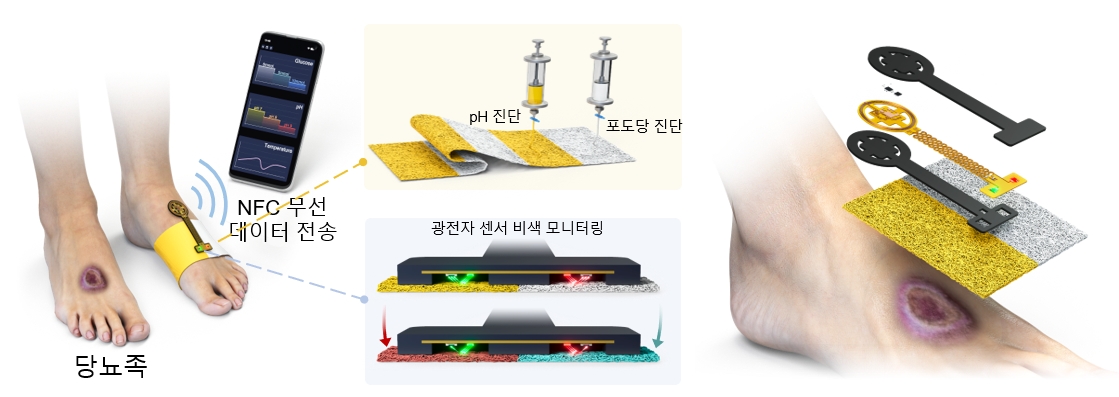
□ 기존의 땀 기반 비색 센서는 산성도(pH)와 같은 지표는 모니터링이 가능하나 당뇨의 지표인 포도당 성분 모니터링은 불가능했고, 성분에 따라 변하는 색상을 스마트폰 카메라 등으로 촬영해 분석해야 했기에 주변 조명(밝기, 그림자)에 따라 오차가 크고 연속 모니터링이 불가능했다.
○ 특히 당뇨 환자의 포도당이나 pH 농도 변화를 의료 수준으로 정확하게 읽어내는 데에는 기술적 한계가 명확했다.
□ 이번 연구는 비색 모니터링 방식을 활용해 당뇨성 질환의 진행 상황과 당뇨족(당뇨성 족부 병변) 등 치명적인 합병증의 징후를 세계 최초로 비침습적으로 모니터링해 냈다는 점에서 혁신적인 성과로 평가받는다.
○ 당뇨족 환부의 포도당 수치 상승과 피부 pH 밸런스 붕괴 현상을 상처 드레싱 형태의 비색 천과 광전자 센서 하나로 24시간 추적 관찰할 수 있어, 조직 괴사로 이어질 수 있는 당뇨족의 위험성을 조기에 경고하고 예방할 수 있는 길을 열었다.
○ 스마트폰을 센서 가까이 대기만 하면 배터리 없이도 구동되며, 측정된 다중 바이오마커(포도당, pH, 체온 등) 데이터가 실시간으로 전송되어 환자와 의료진이 즉각적으로 상태를 모니터링 할 수 있다.
□ 국립한밭대 기계공학과 하지환 교수는 “매일 바늘로 손가락을 찔러야 하는 당뇨 환자들의 고통을 덜어주기 위해 시작된 연구가 치명적인 당뇨족 합병증까지 선제적으로 모니터링할 수 있는 원천 기술 확보로 이어졌다”며, “이번에 개발된 비색 모니터링 기반 광전자 센서는 향후 당뇨뿐만 아니라 다양한 만성 질환의 맞춤형 무채혈 건강 모니터링 시장을 선도하는 핵심 기술이 될 것”이라고 강조했다.
□ 본 연구 결과는 재료과학 분야 최상위 국제 학술지인 ‘어드밴스트 펑셔널 머티리얼스(Advanced Functional Materials, Impact Factor 19.0, JCR 상위 4.5%)’에 정식 게재됐으며, 전면 표지 논문으로도 선정됐다.
(논문명: Wireless, Battery-Free, Optoelectronic, Multi-Modal Sensor Integrated With Colorimetric Dressing for Diabetic Ulcer Management)
□ 한편, 이번 연구는 과학기술정보통신부의 재원으로 한국연구재단(NRF) 중견연구사업, 알키미스트 사업과 2025년도 교육부 및 대전광역시의 재원으로 대전RISE사업의 지원을 받아 수행됐다.
Professor Ha Ji-hwan's Research Team at Hanbat National University Tackles Diabetes and Diabetic Foot with Colorimetric Monitoring... Developing the World's First Wearable Colorimetric Diabetes Sensor
- Joint Research Achievement of Hanbat National University, KAIST, Korea Institute of Machinery and Materials, and California Institute of Technology (Caltech)
- Developing Wireless and Battery-Free Multi-Modal Optoelectronic Sensor Overcoming Limitations of Colorimetric Monitoring Method
- Proving the Possibility of Monitoring Severe Complications Such as Diabetic Diseases and Foot Ulcers (Diabetic Foot) for the First Time in the World Through Precise Color Analysis of Changes in Glucose and pH Concentrations
- Succeeding in Real-Time Continuous Monitoring Only with Smartphone Wireless Communication... Expected as a Next-Generation Non-Invasive Diabetes Management Platform
□ Hanbat National University (President Oh Yong-jun) announced on the 14th that Professor Ha Ji-hwan's research team at the Department of Mechanical Engineering, through joint research with teams from KAIST, Korea Institute of Machinery and Materials, and California Institute of Technology (Caltech), has developed the world's first 'wireless and battery-free multi-modal optoelectronic wearable sensor' capable of monitoring severe complications such as diabetes and diabetic foot in real-time through colorimetric monitoring (color change analysis) of sweat without drawing blood.
○ This research was led by Professor Ha Ji-hwan of the Department of Mechanical Engineering at Hanbat National University and Dr. Cho Seok-ju of the Department of Mechanical Engineering at KAIST as co-first authors, and yielded world-class convergence research results with the joint participation of KAIST Endowed Chair Professor Park In-kyu, Principal Researcher Jeong Jun-ho of the Nano-Lithography Research Lab at the Korea Institute of Machinery and Materials, and Professor Wei Gao's team at the California Institute of Technology.
□ Conventional sweat-based colorimetric sensors could monitor indicators like acidity (pH) but could not monitor glucose, an indicator of diabetes. Since they required photographing and analyzing the colors that change according to the components with a smartphone camera, they had large errors depending on ambient lighting (brightness, shadows) and could not perform continuous monitoring.
○ In particular, there were clear technical limitations in accurately reading the changes in glucose or pH concentrations of diabetic patients at a medical level.
□ This research is evaluated as an innovative achievement in that it successfully monitored the progress of diabetic diseases and signs of fatal complications such as diabetic foot (diabetic foot ulcer) non-invasively for the first time in the world using the colorimetric monitoring method.
○ The rise in glucose levels and the collapse of skin pH balance in the affected area of the diabetic foot can be tracked and observed 24 hours a day with a single colorimetric cloth in the form of a wound dressing and an optoelectronic sensor, opening the way to issue early warnings and prevent the risk of diabetic foot, which can lead to tissue necrosis.
○ It operates without a battery simply by bringing a smartphone close to the sensor, and the measured data of multiple biomarkers (glucose, pH, body temperature, etc.) is transmitted in real-time, allowing patients and medical staff to immediately monitor the condition.
□ Professor Ha Ji-hwan of the Department of Mechanical Engineering at Hanbat National University emphasized, "The research, which started to alleviate the pain of diabetic patients who have to prick their fingers with a needle every day, has led to securing original technology capable of preemptively monitoring even fatal diabetic foot complications." He added, "The newly developed colorimetric monitoring-based optoelectronic sensor will become a core technology leading the customized bloodless health monitoring market for various chronic diseases as well as diabetes in the future.“
□ The results of this research were officially published in 'Advanced Functional Materials (Impact Factor 19.0, Top 4.5% in JCR)', a top-tier international academic journal in the field of materials science, and selected as the front cover paper. (Paper Title: Wireless, Battery-Free, Optoelectronic, Multi-Modal Sensor Integrated With Colorimetric Dressing for Diabetic Ulcer Management)
□ Meanwhile, this research was conducted with the support of the Mid-career Researcher Program and Alchemist Project of the National Research Foundation of Korea (NRF) funded by the Ministry of Science and ICT, and the Daejeon RISE Project funded by the Ministry of Education and Daejeon Metropolitan City in 2025.
[Press Release Translation: Student Press Corps Global Team]